Posts

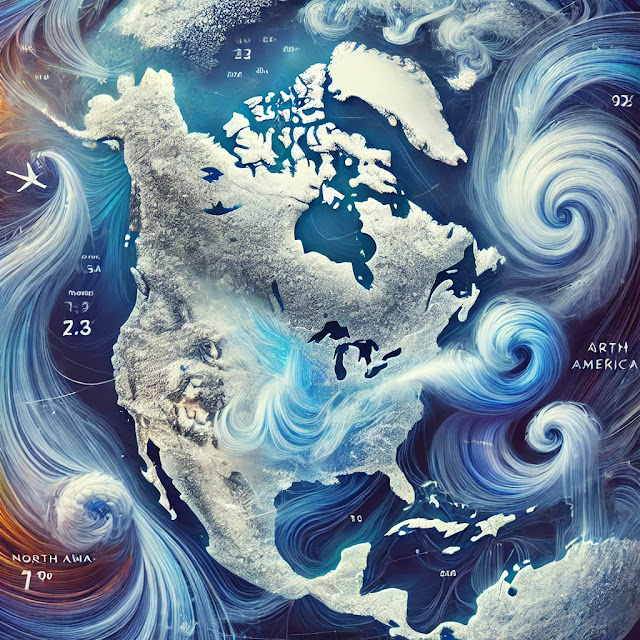
Extreme Cold Warning in the United States: The Science Behind the Deep Freeze
Image
Extreme Cold Warning in the United States: The Science Behind the Deep Freeze Introduction As temperatures plummet across the United States, extreme cold warnings have gripped large portions of the country. The bone-chilling cold isn't just inconvenient—it's dangerous, affecting millions of lives and disrupting daily activities. But what causes such extreme cold spells, and how does science explain these phenomena? Let’s delve into the meteorological and scientific reasons behind these frigid temperatures. What is an Extreme Cold Warning? An extreme cold warning is issued when temperatures or wind chill values are so low that they pose a risk to public safety. Frostbite, hypothermia, and other cold-related illnesses become real threats in these conditions. The thresholds for such warnings vary depending on the region but are typically issued when the wind chill drops to dangerous levels. The Science Behind the Arctic Chill Polar Vortex The primary driver of extreme cold in the...

Earthquake

Image
Earthquake  Earthquake , any sudden shaking of the ground caused by the passage of   seismic waves   through   Earth ’s rocks. Seismic waves are produced when some form of energy stored in Earth’s crust is suddenly released, usually when masses of rock straining against one another suddenly fracture and “slip.” Earthquakes occur most often along geologic   faults , narrow zones where rock masses move in relation to one another. The major   fault   lines of the world are located at the fringes of the huge tectonic plates that make up Earth’s crust. ( See   the   table   of major earthquakes.) Building knocked off its foundation by the January 1995 earthquake in Kōbe, Japan. Dr. Roger Hutchison/NGDC Residents of an earthquake-damaged neighbourhood of Port-au-Prince, Haiti, seeking safety in a sports field, Jan. 13, 2010. The magnitude-7.0 earthquake struck the region the day before. Petty Officer 2nd Class Sondra-Kay Kneen/U.S. Coast...

Life on Venus

Image
 Life on Venus Deep within the acid clouds above Venus,   astronomers have detected something new, that could be sign of life. The gas phosphine, a toxic molecule with an order of garlic and dead fish. Astronomers discovered the compound in a cloud layer where temperature was fairly close to the temperature to those of earth surface. Phosphine is exciting because of where it comes from. On earth, it is either manufactured by humans, or it's natural byproduct of life. It just doesn't show anywhere else, and there's no human manufacturing on Venus. Phosphine is not sure fireproof there are alien microbes on the cloudy planet, but it does mean that something is going on there. Something that we don't understand. "We are  not   claiming we have found life on Venus," MIT planetary scientist and study co-author Sara Seager emphasized a few minutes later. "We are claiming a confident detection of phosphine gas whose existence is a mystery." The research ...

Schrödinger’s Cat

Image
Schrödinger’s Cat Erwin Schrödinger’s goal for his infamous cat-killing box was to discredit certain non-intuitive implications of quantum mechanics, of which his wave mechanics was the second formulation. Schrödinger’s wave mechanics is continuous mathematically, and deterministic. Werner Heisenberg’s matrix mechanics is discontinuous and indeterministic. Schrödinger did not like Niels Bohr’s idea of “quantum jumps” between Bohr’s “stationary states” - the different “energy levels” in an atom. Bohr’s “quantum postulate” said that the jumps between discrete states emitted (or absorbed) energy in the amount hν = E2 - E1 .  Bohr himself did not accept Albert Einstein’s 1905 hypothesis that the emitted radiation is a discrete quantum of energy hν, later known as a photon. Until well into the 1920’s, Bohr and Max Planck, the original inventor of the quantum hypothesis believed radiation was a continuous wave of the kind defended by Schrödinger. This raised the question of wave-part...

The Theory of Relativity

Image
The theory of relativity by Albert Einstein   In 1915, Albert Einstein revolutionized physics. He described in the General Theory of Relativity how gravity arises when space and time writhe. In November 1915 Albert Einstein explained a radically new world view to the Prussian Academy of Sciences with the General Theory of Relativity. Accordingly, masses and rays of light do not merely move through space and time - space and time themselves merge into a structure that constantly curves and changes. Heavy bodies distort their geometry, even light then runs on curved tracks.   Extreme consequences are such exotic objects as black holes, the researchers have not understood until today, or gravitational waves whose direct detection still failed. And how Einstein's cosmos could be reconciled with the equations of quantum physics - this will probably be one of the greatest tasks of theoretical physics of the current century.  The theory of relativity is essentially about experie...

Material science

Image
Material Science   Sometimes it is useful to subdivide the discipline of materials science and engi neering into materials science and materials engineering subdisciplines. Strictly  speaking, “materials science” involves investigating the relationships that exist  between the structures and properties of materials. In contrast, “materials engi neering” is, on the basis of these structure–property correlations, designing or en gineering the structure of a material to produce a predetermined set of properties. From a functional perspective, the role of a materials scientist is to develop or syn thesize new materials, whereas a materials engineer is called upon to create new  products or systems using existing materials, and/or to develop techniques for pro cessing materials. Most graduates in materials programs are trained to be both  materials scientists and materials engineers. “Structure” is at this point a nebulous term that deserves some explanation. In...

Technology that Knows what you're feeling

Image
Technology that knows what you're feeling What happens when computer knows more about us than we do? A computer now can detect our slightest facial microexpressions and be able to tell the difference between a real and a fake smile. That's only the beginning. Technology has become incredibly intelligent and already knows a lot about our internal states. Whether we like it or not, we already are sharing part of our inner lives that's out of our control. That seems like a problem because a lot of us like to keep what's going on inside from what people actually see. We want to have an agency over what we share and what we don't. We all like to have a poker face.   Scientist have spent a lot of time studying the circuits in the brain that create a unique perceptual realities that we each have. Now we can bring that together with the capabilities of the current technology to create a new technology that does make us better, feel more, connect more. We have to be OK losi...

Aliens and Where are they now?

Image
Where are all the aliens?   Ever since I wondered that, why don't we see flying saucers flitting around? Why don't we see life out there in the cosmos? Frank Drake began searching for alien signals back in 1960 so far, nothing. With each passing year this nonobservation, this lack of evidence for any alien activity gets more puzzling, because we should see them. Best books on science and technology to buy in discount The universe is 13.8 billion years old, if we represent the age of universe by one year, then our species came into existence about 12 minutes before midnight. western civilization has existed for a few seconds. Extraterrestial civilizations could have started in the summer months.  Imagine a summer civilization developing a level of technology more advanced than ours, but tech based on accepted physics. That civilization could program self-replicating probes to visit every planetary system in the galaxy. Intergalactic colonization isn't much more difficult, it...